Nigeria needs approximately 20 million additional homes. Most discussions focus on how quickly those homes can be built. That is an incomplete question. The more important question is what building those homes can do for the Nigerian economy.
Countries that became economic powers did not treat housing merely as shelter. They used housing as an engine of industrialisation, job creation and wealth creation. Nigeria has an opportunity to do the same by using housing policy to deliver Decent Housing, Thriving Industries and Lasting Wealth.
The recent publication regarding a proposed Chinese intervention in Nigeria’s housing sector provides the immediate context for this opinion. It is important to state from the outset that there should be no objection to Chinese participation, or indeed to any credible foreign investor bringing capital, expertise and technology into Nigeria. On the contrary, Nigeria requires significant interventions and partnerships if it is to address its infrastructure and housing challenges at scale.
The issue, therefore, is not whether Chinese companies, or foreign companies generally, should participate. The more important question is whether the structure of such interventions maximises Nigeria’s long-term economic interests. Does the intervention simply deliver houses, or does it use the opportunity to build Nigerian industries, create jobs, transfer skills, strengthen domestic companies and expand productive capacity? That distinction matters because Nigeria’s housing challenge exists within a much broader national ambition: the goal of becoming a US$1 trillion economy.
A trillion-dollar economy cannot be achieved simply by constructing more buildings or importing more goods and services. It requires a fundamental expansion of Nigeria’s productive capacity: more manufacturing, stronger domestic enterprises, higher productivity, better-paying jobs and a larger middle class. Housing provides one of the greatest opportunities to achieve these objectives simultaneously.
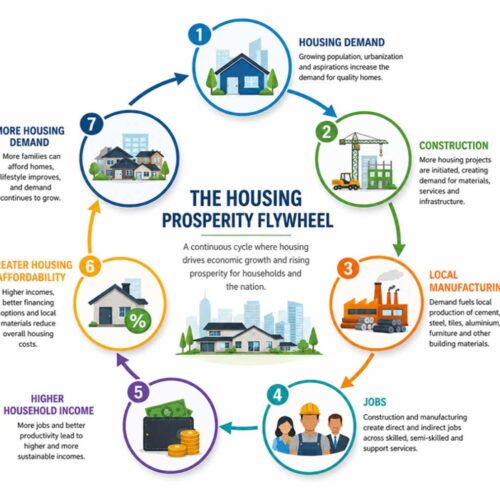
The real measure of success should therefore not only be the number of houses delivered, but the economic capability created in the process of delivering them. Housing has one of the highest economic multipliers of any sector. Every house built generates demand across dozens of industries—from cement and steel to furniture, transport, insurance, banking and professional services.
Housing and Industrial Policy
The world’s most successful economies did not view housing merely as a social intervention. They recognised that housing is also industrial policy. Every housing development creates demand across a broad economic ecosystem. Imagine the economic impact of constructing 500,000 homes annually using up to 80% locally sourced building materials: creating 250,000 direct contruction jobs and more than 1 million indirect jobs, while catalysing demand across major sectors of the economy, such as cement, steel, tiles, furnitute, logistics, engineering, finance, insurance and professional services. A well-designed housing programme does more than provide shelter. It creates factories, develops technical skills, supports small businesses and generates employment far beyond the construction sites.
Countries such as South Korea, Singapore, Malaysia and Turkey deliberately used housing and infrastructure development to strengthen domestic industries that later became internationally competitive. Perhaps the most instructive example is China.
China did not become a global construction powerhouse because it relied on foreign companies to build its cities. It used its enormous domestic demand to develop Chinese manufacturers, construction companies, engineering firms, equipment producers and technology providers. Over time, these companies became global players.
That is perhaps the most important lesson Nigeria should take from China. The objective is not to reject foreign participation but to ensure that foreign participation builds Nigerian capability. Every housing policy should pursue four objectives simultaneously: 1) Shelter 2) Industrialization 3) Employment 4) Wealth Creation
The Difference Between Investment and Imported Growth
There is an important distinction between attracting foreign investment and importing economic activity.
Nigeria undoubtedly needs foreign capital, technology and expertise. However, a predominantly turnkey approach, where foreign companies finance, design, supply and execute projects with limited domestic participation, risks solving today’s housing shortage while missing tomorrow’s industrial opportunity.
Government must therefore carefully weigh not only the intention behind every policy intervention but also its broader consequences.
Every policy decision has economic outcomes. It influences whether local manufacturers invest in new capacity, whether Nigerian contractors develop expertise, whether young Nigerians acquire technical skills and whether domestic companies can grow into competitive enterprises. A policy may achieve its immediate objective while unintentionally weakening the foundations required for long-term economic transformation.
The question policymakers must therefore ask is not simply: “Will this policy deliver houses?” It should also extend to: “Will this policy leave Nigeria with greater productive capacity than it had before?”
This is especially important given the ambition of building a US$1 trillion economy. A trillion-dollar economy cannot be built by importing economic activity. It must be built by expanding domestic production.
Nigeria Has Two Housing Problems, Not One
Much of the housing debate focuses on the shortage of supply. That is certainly a major challenge. However, Nigeria faces another equally important problem: affordability. The depreciation of the naira has fundamentally changed the economics of housing delivery. Construction costs have risen significantly due to foreign exchange pressures, imported inputs and higher financing costs. House prices have inevitably followed. Household incomes, however, have not increased at the same pace. The result is a widening affordability gap.
This reveals a deeper reality: Nigeria’s housing challenge is not only a housing supply challenge. It is also an economic development and wealth distribition challenge. A country cannot achieve mass homeownership if a significant proportion of its population lacks the purchasing power to buy homes. This is a lesson that many successful economies understood.
Broad-based homeownership did not emerge simply because governments built houses or expanded mortgage availability. It emerged because those countries first created productive employment, increased incomes and expanded the economic capacity of their citizens. In other words, prosperity generally precedes widespread homeownership. This is an important distinction for Nigeria.
While homeownership should remain the ultimate aspiration, expecting immediate mass ownership in an economy where incomes remain under pressure may create unrealistic expectations. The more important policy objective should be creating pathways through which citizens can progressively move towards ownership as their economic circumstances improve. This is where rent-to-own models become particularly relevant.
Why Rent-to-Own Should Be a Central Part of Nigeria’s Housing Strategy
If industrial policy addresses the supply side of housing, then rent-to-own addresses the demand side by expanding the number of households able to participate in the market. Rent-to-own should not be viewed as a compromise or a second-best alternative to ownership. In many countries, rental housing has played a critical role in allowing citizens to access secure accommodation while economies develop and household wealth accumulates.
At different stages of economic development, many successful societies recognised that immediate homeownership was not always realistic or desirable for every household. Strong rental markets provided stability, while rising incomes and asset accumulation gradually enabled more people to transition into ownership. The mistake is to assume that ownership must always be the starting point of housing policy. In reality, ownership is often the outcome of economic progress.
For millions of young Nigerian professionals, entrepreneurs, informal sector workers and families with stable incomes but limited savings, the challenge is not the willingness to pay. The challenge is the inability to immediately meet the deposit requirements and financing conditions associated with mortgage ownership.
A well-designed rent-to-own model creates a bridge. It allows households to secure decent housing today while gradually building equity towards ownership tomorrow.
It also aligns housing policy with the broader objective of wealth creation. Rather than placing families into mortgages they may struggle to sustain, it allows ownership to develop alongside increasing incomes and financial capacity. This should form an important second phase of MREIF.
The Next Evolution of MREIF: Building on a Successful Foundation
The establishment of the Ministry of Finance Incorporated Real Estate Investment Fund (MREIF) represents one of the most important and innovative interventions in Nigeria’s housing sector in recent years. Its introduction of a single-digit mortgage rate structure addresses one of the most significant historical barriers to homeownership in Nigeria: the absence of affordable, long-term housing finance.
For decades, the Nigerian housing market has been constrained by mortgage rates that made homeownership inaccessible to a large proportion of the population. By addressing this challenge, MREIF has created a more credible pathway towards ownership and has demonstrated the important role that government-backed financial innovation can play in unlocking the housing market. Since its inception in March 2025, MREIF has disbursed a total of N140bn through 21 financial institutions towards the creation of 2018 mortgages in 27 states. This achievement should not be understated.
The objective should be to amplify and expand the success of MREIF, not to question its relevance. However, as important as affordable mortgage finance is, Nigeria’s housing challenge is multidimensional. Access to financing is a necessary condition for homeownership, but it is not the only condition. While mortgages solve the financing challenge, they do not, by themselves, solve every affordability challenge.
The ability of households to access mortgages ultimately depends on broader economic factors: income levels, employment stability, housing prices, construction costs and household wealth. This is why the next phase of MREIF should build on its current success by expanding the housing ecosystem around it.
Beyond providing affordable mortgage finance, MREIF could become a broader platform that supports the supply side of the market by encouraging lower-cost housing production, supporting domestic manufacturers of building materials, providing development finance to credible developers and promoting modern construction methods that reduce costs.
Equally important, MREIF should recognise that Nigeria’s pathway to widespread homeownership will evolve as the economy grows. Many Nigerians today may not yet be ready for immediate mortgage ownership, not because they lack aspiration or commitment, but because their income and accumulated wealth have not yet reached that stage. This is where a complementary rent-to-own model becomes valuable.
Rent-to-own should not be viewed as an alternative to MREIF’s mortgage success. Rather, it should be viewed as an additional pathway that expands the number of Nigerians who can eventually benefit from homeownership. It provides a bridge for households who can afford rental payments today but need time to build equity, savings and financial capacity before transitioning into full ownership.
In this way, MREIF can serve both those who are ready for ownership today and those who are on the journey towards ownership tomorrow. The ultimate ambition should be a housing ecosystem where affordable mortgages, rent-to-own pathways, lower construction costs and rising household incomes work together to make sustainable homeownership achievable for millions more Nigerians.
A Better Framework for Foreign Partnerships
None of this argues against foreign participation. Nigeria should welcome investors who bring capital, technology and expertise. However, partnerships should be structured around national development objectives.
The key question should be:
When this project is completed, what additional capability will Nigeria possess? A successful partnership should leave behind more than completed buildings. It should create Nigerian suppliers, skilled workers, manufacturing capacity, stronger local companies and technology transfer. Foreign expertise should accelerate Nigerian capability, not replace it.
That is how countries have successfully used global investment to build national prosperity.
Building More Than Homes
Nigeria unquestionably needs more houses, but it needs something even more fundamental: an economy in which millions more Nigerians can afford those houses. The housing deficit should therefore not be viewed merely as a construction problem. It should be seen as one of Nigeria’s greatest opportunities to accelerate industrialisation, create employment, deepen manufacturing, increase incomes and expand the middle class.
The objective should not simply be to build 10,000 homes through a foreign contractor. The objective should be to use those 10,000 homes to build the industries, skills, companies and wealth that enable Nigeria to build the next one million. If Nigeria approaches housing with that mindset, it will not merely reduce a housing deficit, it will create one of the foundations required to achieve a US$1 trillion economy.
The true measure of success is therefore not how many houses are completed. It is whether the process of building those houses leaves Nigeria stronger, more productive and more prosperous than before.
Housing policy is not simply about shelter. It is about nation-building.