
5 Investment Principles to Use During an Election Period

5 Investment Principles to Use During an Election Period

Okoro was busy talking to himself, murmuring in his room after looking at his investment portfolio and reviewing the current situation in the country. What do I do now? Election is coming up in 3 months – will the incumbent be retained, or will a new president be voted into power? There is so much uncertainty. Where do I keep the funds I intend to invest, and where do I transfer my existing investment portfolio to maximize returns? Okoro was disturbed.

Just before the last election, he withdrew his investments from the stock market only to hear that there was a growth of 12.5% over a 3-day period immediately after the announcement that a new president was voted into power as well as the peaceful transition that followed.

Okoro wants to know how he can manage the situation this time to get the best value from his investment portfolio and ensure he never gets broke?

Hmmm…. Let’s try to provide some solution to Okoro’s dilemma……

Election comes every 4 years but we have financial goals to achieve regardless of who wins- incumbent continues with the existing policies or a new winner emerges and promotes new policies to better the achievement of the previous government. These actions are not expected to influence your investment goals if you always apply the five investment principles highlighted below;

  1. Be clear on your financial goals- Why are you keeping the funds away? How long are you looking at? Apply the SMART acronym to your goals- ensure that your goal is Specific, Measurable, Achievable, Realistic and Time Bound.
  2. Know your financial status- What is your Net worth? Deduct your liabilities (what takes money away from you) from your assets (what makes money for you). Measure your cash flow and expenses with the help of a Budget. All of these would help you create a convenient savings plan towards achieving your financial goals.
  3. There are so many goals running through your mind. Therefore, it is required that we split our goals into 3 different categories namely: Short term (those you want to achieve in 2 years), medium term (those you want to achieve between 2 to 10 years) and long term (those you want to achieve above 10 years).
  4. Implement your strategies- You need to understand that the different financial instrument available are suitable for specific category of goals identified above. For instance, short term instruments are Treasury bills, Money Market Fund. Medium Term are Balanced mutual fund while long term are Stocks and real estate. You might need a Financial Advisor to help out.
  5. Review your investment- Align your investment plan with new policies to ensure you are making the most value for yourself. Always review your short-term investment every 3 months, medium term goals every 6 months, Long term goals annually.

These are tested and trusted principles that will provide the hedge required on your investment portfolio at all times regardless of what changes in the economy.

The post 5 Investment Principles to Use During an Election Period appeared first on Realising Ambitions.
#ILoveMyFamily: (Episode 1): Welcome to Our World

#ILoveMyFamily: (Episode 1): Welcome to Our World

My name is Lakunle. I am a husband, a father of two, and a salary earner. I married my wife, Chindima, the most beautiful woman in the world as far as I am concerned, five years ago when I started working.

I met my wife during my National Youth Service Corps year in Enugu and we became best of friends. We had good plans. We shared our life goals and we were ready to take on the world.

My two children, Nifemi and Chinedu, are very special to me. Nifemi is the older of the two. We had her on the day of our 1st wedding anniversary; every 24th of July is always a day full of fun activities in the family.

Nifemi is just like her mother: beautiful and enthusiastic. She has started behaving like a woman at age 4. She now helps in the kitchen and runs errands within the house. She is going to be a responsible woman someday.

Our little boy Chinedu is 2 years old. I love to call him Chinny and he somehow likes it because he usually giggles happily whenever I call him that name. He is one of the most energetic 2 years old boys I have seen.

One of the things I love about my wife is her cooking skills. I am not bragging, my wife is the best cook in the world. Ever since we got married, I can count the number of times I eat out. My friends can testify to the fact that my wife cooks better than anyone else. Whenever they visit, they always look forward to eating our food.

My wife is a salary earner like me. I have always wanted her to own a restaurant so that she can start making money with her talent. Two years ago, when we discussed this, she said she was not ready for it. She said when the time comes, she would let me know. I didn’t mention it again and we seemed to have forgotten about it until recently when she raised it again in the middle of the night.

“Dear, there is something that has been troubling my mind.” She said.

“What is it baby?” I asked curiously.

“Did you remember sometimes ago when you wanted me to open a restaurant? I have been giving it a lot of thought recently. I think it’s high time we had a business of our own.”

I saw her desire and I promised to help her with a business plan. We found out that for us to start a very good restaurant in our neighborhood, we will need nothing less than N3 million. We both agreed that we were not going to borrow the money for it, instead, we would save towards it.

We started looking for a good platform and a friend introduced us to a platform he has been using for a long while: ARM Life Saving Plus He said we were going to get interest at the expiration of our saving tenure, that makes so much sense to us and we didn’t hesitate to start the journey towards realizing our ambitions.


Join us for the next episode next week


The post #ILoveMyFamily: (Episode 1): Welcome to Our World appeared first on Realising Ambitions.
How to deal with the inevitable expenses of 2019

Some things remain constant with each year while some new situations welcome themselves regardless of our level of preparedness. Here are some things that will likely gulp your money in 2019 apart from your daily home expenses.


School fees – If you’re a parent, you must know that you will pay school fees thrice this year. The last one in September being of a bigger sum because your child will be entering a new class which will demand some financial responsibilities.

Valentine’s Day – February still has 14th on it and the world will mark Valentine’s Day. Unless you are a Valentine’s Day Grinch with nobody to gift, you’ll be spending some money this season

Elections – This is the year of elections and as a Nigerian, you must remember that uncertainty looms. Instead of waiting to be thrust into the unknown, it is wise to make plans to ensure that however the tides turn, you and your family remain largely unaffected.

Easter and Eid celebrations – Whether Christian or Muslim, you will be marking these special seasons in 2019 and they will require some expenses. Knowing and planning is the surest way to have a joyous celebration without going broke afterwards.

Special birthdays – Be it that of your spouse, child, friend, parent or relatives – birthdays are those celebrations that we don’t count but often leave a hole in our pockets if we don’t budget for them.

Rent – This is an inevitable expense unless you currently live in your own home. Plan for it as well.

Big celebrations – If this is the year you plan to wed, put a down payment on your first home or buy your first car amongst other big celebrations, then it is an inevitable expense for you – one that requires planning. The first month of the year is the right time to start planning towards these big steps and the best investment vehicle is your best option to being financially prepared for them.

Latest brand of gadgets – iPhone may announce an upgrade to their latest version as can other companies. Be prepared for this announcement and decide ahead of time if you really need it. If yes, now is the time to start investing towards it.

The unexpected – Emergency car breakdown, hospital bills, last-minute travel expenses… name it. Because you know that life can throw you an unexpected curveball at any point, it is wise you have an emergency fund somewhere for the just-in-case moment.

Discounts and deals – With every celebration, businesses offer you deals and discounts. Expect no less in 2019 and brace yourself for them. Whether it is Easter deals, Black Friday discounts, End of the year sales – expect it and plan for or against it.

Christmas – Oh no, it’s not too early to recognize that Christmas gulps a good amount of money and can leave many accounts red. But not if you invest early towards it. Did you know that investing as little as N1000 every other day this year can have you balling through Christmas in the lifestyle you desire? Think about it.

2019 can be rosy for you if you start early to plan for the inevitable and invest appropriately to tend to them.


Meet all your 2019 expenses by investing towards them starting now. Check out investment options at www.arminvestmentcenter.com

The post How to deal with the inevitable expenses of 2019 appeared first on Realising Ambitions.
Source: Blog

4 reasons to get life insurance policy this 2019

4 reasons to get life insurance policy this 2019

The topic of getting life insurance is one you may not want to talk about. But because it is important that you ensure the financial security of people that depend on you, it is worth dealing with.

First, let us break down why you need one.

If you’re a breadwinner, you need a life insurance

Let’s be real, if you are the main financial backbone in your family and anything happens to you, your partner, children and anybody else that depends on you, will probably suffer financially. This is one of the major reasons people get life cover; to ensure a safety net for their loved ones in the face of unforeseen circumstances. With the rising cost of education, you can ensure that your kids will still be able to get the education they deserve should the worst happen.

It is not anticipating bad omen. It is simply facing reality and planning for it.

Got loans?

This is one that you might not have thought about. What becomes of your family if you have taken a loan or got a mortgage and something happens to you and there is no one to pay it off? Proceeds from your life insurance policy can be used to settle these loans ensuring that if the worst happens, your family doesn’t have an additional debt to deal with.

Single but responsible

Now, being single doesn’t mean you don’t have anyone that depends on you financially. It could be an elderly parent, sibling or relative. Having a life cover will make sure that these people you care about will be taken care of regardless of your presence, giving you and them peace of mind.

If you need to take care of future medical expenses

If you can’t predict the future, then you never know what may happen. A life protection plan comes in handy in the event of injuries, accidents or terminal illnesses which may prevent you from working. It saves you and your loved ones from unplanned and expensive medical bills.

While life insurance protects your family in the event of uncertainty, there are also lots of other benefits to getting one. Haven’t already taken out a life insurance? It’s not late.

Get in touch with us today via [email protected] to discuss your options.

The post 4 reasons to get life insurance policy this 2019 appeared first on Realising Ambitions.

How 2019 Looks for you as an investor

How 2019 Looks for you as an investor

With the New Year in sight, it is normal for every investor – including you – to feel a bit of apprehension. You might begin to wonder what the future holds, how the market will fare and whether to increase your investment. All these are valid thoughts and we’ve gone ahead to gather answers to your silent questions.

How 2019 looks for you as an investor

In the Equities Market:

In 2019, the Nigerian economy will stay focused on oil prices output and the currency. These factors, we believe weigh heaviest on investor confidence, and exerts significant influence on our macro environment.

However, while major sell-offs continue to take hold on the equity market, smart fund managers like ARM will continually seek and take advantage of lower prices to position on securities with sound financial and positive earnings growth prospects.

On Fixed Income:

In 2019, there is a high possibility for tighter interest rate environment hinging on high maturity levels and Foreign Portfolio outflows due to hike in Federal Reserve rate and perceived election risks – plus possible higher borrowings by the Federal Government. More so, the likelihood of an increase in fuel price in 2019 will stoke inflationary pressure and force the monetary policy to keep interest rate elevated.

Knowing all of these, we will invest near maturing instruments in short-term instruments taking advantage of the attractive rates that we believe are available in the near term.

What this means for you as an investor

This means that the thought of how your investment will fare in 2019 should no longer make you panic because, regardless of what the economy may look like, there is already a plan in place to combat any possible glitch the market may encounter.

Past fund performances and track record of ARM Investment Managers are pointers to how safe your investments are with us. Look at how our funds have performed in the last three years. Based on presented statistics, you can rest easy knowing that your investments are safe and growing. This is also a positive nudge to consider increasing your investment in the New Year.

Click here to invest today


Benchmark breakdown


Aggressive Growth Fund


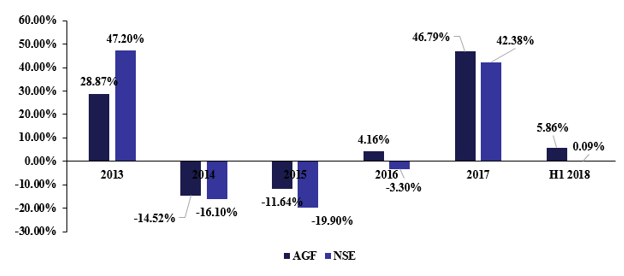
ARM AGF comprises of equities (87%) and fixed income (13%). This means that its return is determined by the performance of these respective indexes. Over the last 4 years, AGF and the NSE Index have followed the same trend, with ARM outperforming its benchmark in 2014 – H1 2018.


Discovery Fund


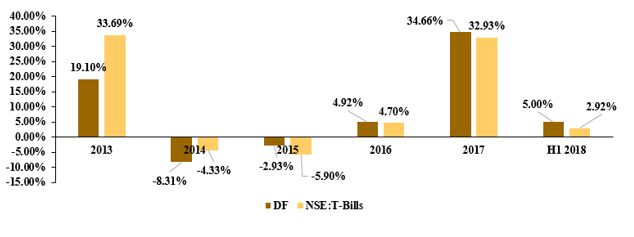
ARM DF comprises of equities (62%), fixed income (37%) and real estate (1%). As a result of its composition ,it is benchmarked against a ratio of the NSE index (equities) to T-Bills (fixed income). DF lagged behind its benchmark in 2013-2014. However, from 2015 – H1 2018 DF outperformed its benchmark


Money Market Fund

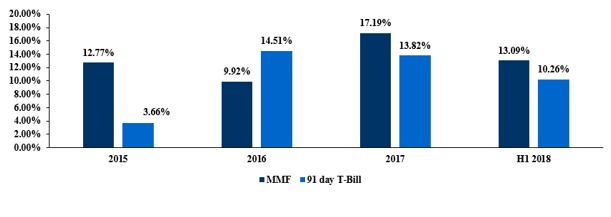
ARM MMF is benchmarked against the 91-day T-Bill. In 2015, 2017 and H1 2018, the yield from ARM’s MMF outperformed its benchmark.


Ethical Fund

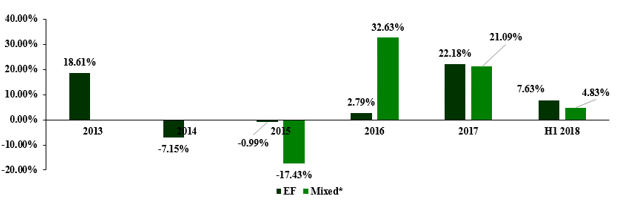
ARM Ethical Fund’s benchmark is based on the performance of Lotus, Skye Shelter and Osun Sukuk. EF outperformed its benchmark in 2015, lagged in 2016 and has seen improvements in its performance over the last year.


We are available via [email protected] or 0700 CALL ARM should you wish to get in touch with us.


Thank you.


The post How 2019 Looks for you as an investor appeared first on Realising Ambitions.

Access Bank Plc and Diamond Bank Plc Merger: A Lofty Deal or Damp Squib?

Access Bank Plc and Diamond Bank Plc Merger: A Lofty Deal or Damp Squib?

Nigerian Banks

A Lofty Deal or a Damp Squib?
• A switch to National Banking License… In our recently published equity commentary on Diamond Bank (See report: Overblown fright or Justified concerns), we had stated three options the bank’s management will adopt to keep the bank operational and meet its obligation to lenders. While we had considered the possible acquisition by a bigger bank, the management of both banks in separate press releases refuted the claim. Consequently, as with one of our options, Diamond Bank got approval from the CBN to operate as a national bank following the sale of its UK business, a development that was perceived to have saved the bank from capitalization needs and continue operations on a better footing.

• …and then a Scheme of Merger. To our surprise, news broke over the weekend of a possible merger between both banks, with the management of Access Bank Plc and Diamond Bank Plc yesterday separately issued releases on the Nigerian Stock Exchange (NSE) stating the planned acquisition of Diamond by Access with a consideration price of N3.13/share. This is on the consideration of N1.00 in cash for one share of Diamond bank held and 2 new shares of Access for every 7 shares of Diamond. Accordingly, we estimate total cash consideration of N23 billion and new allotted shares of 6.6 billion units in Access Bank. We note that the consideration price is 213% above the closing market price of N1.0 per share of Diamond yesterday.

• Estimating the transaction multiples. As at 9M 2018, Diamond bank’s book value stood at N217.1 billion with a book value per share (BVPS) of N9.37, we estimate a transaction price to book multiple (P/B) of 0.3x compared with the market valuation of 0.1x P/B. Given our thought that the transaction is strictly equity based, we assume a situation wherein the un-provisioned part of the non-performing loan is adjusted for through equity to leave the books with performing assets. As such, based on current NPL of N99 billion and total credit charge loss of N54 billion, we estimate an equity charge of N45 billion by Diamond bank over Q4 18 to leave the book value at N172.1 billion and BVPS of N7.4 with implied transaction price to book multiple of 0.4x.

• How they Stack up Post Consolidation. The notice by Access indicated that the bank will issue additional shares of 6.6 billion shares to accommodate the shareholders of Diamond bank. Assessing the impact on current outstanding shares of Access bank of 28.9 billion, we estimate increase in total shares post consolidation to 35.5 billion. Accordingly, we estimate that the potential dilution from the merger of 19%. Furthermore, post-merger, Carlyle Group, Kunoch Holdings and Diamond Partners will own 3.3%, 1.7% and 1.1% of the enlarge Access bank respectively.

• Expected Moderation in Cost of Funds. During our engagement with the management of Access Bank in November, they guided to the bank’s plan to gradually close out on expensive borrowings. Specifically, the CFO stated that the bank could refinance its expensive Eurobonds if presented with the opportunity and any other available opportunity that could result in a significant moderation in its funding costs. Notably, as at 9M 18, Access cost of funds stood at 5.6% compared to Tier 1 average of 4.0%, following contraction in cheaper deposit (current and savings account) mix by 195bps to 45% which resulted in 18.5% YoY jumps in interest on customers deposits, 1.0x YoY growth in interbank placements, and 73.8% YoY increase in borrowing cost. However, Diamond cost of funds remains the lowest among peers at 4% (coverage Tier 2 average of 5.4%) despite a 260bps YoY contraction in CASA composition to 78.3% over 9M 18. Accordingly, we see some benefit to Access in terms of moderation in funding cost from the acquisition of Diamond and estimate that Access’s cost of funds could moderate to ~5.1% with a CASA mix of ~55.3% post consolidation.

• However, given the reaction to the bank in recent months, we are cautious on the level of cheaper deposits composition being inherited by Access bank. For context, over the last five quarters, Diamond bank has lost CASA deposits of N247.6 billion, reflecting a 22.8% decline YoY to N836.7 billion in Q3 18 from N1.1 trillion in Q3 17. Also, given the lower credit rating of Diamond bank, in terms of corporate deposits, we do not rule out the possibility of erosion in Access bank’s credit rating.

• What’s the immediate Impact? In summary, while this acquisition appears positive for shareholders of Diamond Bank, we are of the view that the transaction will be undesirable for Access Bank in the near term, giving bottlenecks in terms of collapsing of structures as well as dilution impact on profitability metrics. That said, we await meeting with Management of Access Bank tomorrow (Click here for conference detail) for further details and discussion on this acquisition and would communicate our views in due course.

• Any benefit for the core investors in Diamond? Following the exit of Actis in August 2014 and the need for recapitalization of the bank in November 2014 via a rights issue, Carlyle Group, became the largest single shareholder in Diamond with transaction valued at $147 million (N7.38 per share). Accordingly, we estimate that on current price of N1.07, the Group is taking a bad hit on the investment to the tune of N20 billion. Accordingly, we believe that the consideration price of N3.13 could reduce Carlyle loss in the venture to ~ N11.4 billion in the short term. However, post consolidation and integration of the shareholders into the enlarged Access bank, we believe the change in the fortune of Carlyle in the venture will be determined by the gains from the integration.

Download full report below

Access Bank Plc and Diamond Bank Plc Merger – A Lofty Deal or Damp Squib

The post Access Bank Plc and Diamond Bank Plc Merger: A Lofty Deal or Damp Squib? appeared first on Realising Ambitions.

My uncle’s children

My uncle’s children

My cousin Gerald has visited again. This time, he is staying for one month to buy all the necessities for his first year at the University. Dad would be funding it as usual. I and my five siblings have gotten used to seeing my dad fund his nephews’ education while my uncle did his best to keep populating the world.

My mum wasn’t against dad helping his nephews, but she kept prodding dad to save some money for his own children’s education as well since we were all still quite young. Dad didn’t understand her. He believed that if he gives the best to his brother’s children, his brother or maybe someone else would do the same for him. In truth, I think he never really envisaged that his business would go under before his own kids were grown – he was so sure of this that he asked mum to resign from her government job as a teacher. Unfortunately, the business stopped doing well and thank God mum didn’t resign.

Growing up, I and my siblings lived a life of managing. Dad became a sad version of himself especially when we asked for money for the basic needs as students. It was almost as though we shouldn’t ‘need’ anything. Back in the University, we weren’t the kids that carried the latest phones, or wore the best clothes or even had the required textbooks. We were the kids that made do and never complained.

Mum soon took over the financial reigns as dad’s business completely crumbled. Seeing her struggles fostered some form of discipline in us all to succeed and make her and dad proud. Did my uncle finally help out financially? I wish. He never even looked our way again.

Somehow, we all scraped and managed till today. Today, I own a multimillion naira apparel business alongside my lucrative consulting role in an Oil and Gas firm while my other siblings are doing good in their careers and businesses.

Every day I remember how we all got here. How mum put in her sweat and blood – and how dad miscalculated with his finances and when we were little.

Yes, we all turned out well, but would we have if mum didn’t make all the sacrifice? What if dad had saved for our education like mum persuaded him to? I know a lot of people will say that the struggle made us better people. That is true only because of the upbringing mum gave us and her kind of woman. I’ve seen families that went through what we did, and it shattered their future.

I’ll be a fool to allow the thunder strike twice in the same place. That is why the moment our twins were born four years ago, I got an education plan for them as well as a trust fund. Life has taught me enough lessons, so I know better than to leave anything to chance.

I still take care of needs from extended family but at least I’m at peace knowing my wife and children will never have to struggle through life like I did.


The post My uncle’s children appeared first on Realising Ambitions.

ARM Research – Stock Recommendation for the Week , December 17

ARM Research – Stock Recommendation for the Week , December 17

Activities in the Nigeria equities market was bearish in the past week, with the NSE ASI declining by 0.60% WoW to 30,681.50 points and market capitalization shedding about N61.8 billion over the week. The loss was driven by declines in bellwether stocks in the banking (FBNH: -1.97%, STANBIC: -2.34% and ZENITH: -2.34%), Breweries (NB: -0.63%) and Food (NESTLE: -6.39%) sectors. Top decliners during the week were MOBIL (-10.41%), CONOIL (-10.00%) and CUTIZ (-9.64%).

 Fidelity Bank Plc – BUY (FVE: N2.92). We are more optimistic on our earnings expectation over 2018 largely on the back of lower loan-loss provisioning. We have revised our FY 18E EPS higher to N0.82 (previously N0.76) which is 25% higher YoY. Our FVE of N2.92 (previously N2.82) translates to a BUY rating on the stock. Based on Friday’s closing price, our dividend expectation translates to a dividend yield of 8%.

 Nigerian Breweries Plc – SELL (FVE: N76.58): Reflecting the industry competition and further declines in volumes into Q4 18, we forecast FY 18E revenue to decline by 6.8% YoY to N321 billion. However, we envisage cost pressures due to rising barley prices. Thus, we forecast FY 18E gross margin at 40.8% (FY 17: 41.7%) and EBIT margin of 12.6% (FY 17: 17%). Having rolled forward our model, we cut our FVE on NB to N76.58, translating to a SELL.

 Unilever Nigeria Plc – STRONG BUY (FVE: N47.58). Unilever is our top pick in the consumer space with FY 18E EPS expectation of N2.11 (+18.2% YoY), based on revenue growth (+9.7% YoY) and significant moderation in interest expense (-90.1% YoY) – following the sizeable deleveraging of its balance sheet.

 Dangote Cement Plc – STRONG BUY (FVE: N253.03): We have lowered our FVE on DANGCEM to N253.03 largely due to a downward revision of 2018 and 2019 volume growths. The revision reflects the impact of the prolonged rainy season and electioneering concerns which has now slowed ongoing infrastructure projects. However, we believe DANGCEM presents an attractive entry point in the cement sector in Nigeria given its strong and diversified margins and balanced funding structure.

 Lafarge Africa Plc – SPECULATIVE BUY (FVE: N18.07). We have lowered our FVE on Lafarge to N18.07 as we now expect a more significant dilution from the N89 billion Rights Issue and a downward revision to our 2019 volumes growth. Based on current price, our FVE translates to a BUY. However, we are highly cautious on Lafarge and thus rate the stock a SPECULATIVE BUY.

Kindly, visit ARM Research Portal for full stock reports.

The post ARM Research – Stock Recommendation for the Week , December 17 appeared first on Realising Ambitions.

Don’t be like Uncle Jimoh

Don’t be like Uncle Jimoh

The moment I crossed that finish line and felt the coldness of the medal as it was hung around my neck, I felt truly victorious.

When 2018 began, I had pledged to be a healthier version of myself, get serious with investing, get married and begin planning my retirement. The latter was informed by my uncle’s heart-attack on his 65th birthday which the doctor relayed was partly due to his hard work and little or no rest. You see, Uncle Jimoh had retired but had to keep working at a Primary School to make ends meet.

His children could have taken care of him, but even those two are still trying to find their feet financially. After his burial, I wondered how different things would have turned out had Uncle Jimoh had some millions in his retirement account and didn’t have to work so hard to earn a living. Perhaps, he might still be alive today.

Well, as a sharp guy with common sense, I did the mathematics and research. If I wanted to live long, I might as well do it healthier. If I wanted to live wealthy, I might as well start investing. If I didn’t want to be paying school fees in my 50’s, I might as well marry early and most of all, if I wanted a retirement free of hassles, I might as well start growing my retirement savings account.

A crucial step

So you see, crossing that finish line at the ARM Pension’s Run For The Future run/walk event on November 24, 2018, was a very crucial step in forging ahead with redeeming my pledge to myself this year. That makes it three things I have succeeded in checking off my list this year.

The first one about investment was super easy. I simply found a great investment vehicle that suited me and went with it. The second was even easier – topping up my RSA. Since my Pension Managers were so reliable, all I had to do was put a call across to indicate interest in making Additional Voluntary Contributions to boost what my employer deposits into my RSA and like Aladdin making a wish, my wish was granted. Now I rest easy knowing my investment is growing, retirement fund is bulking up and my fitness is on track – it has to be because I completed the 8K race…yippee!

Now I have only one thing left on that list. Marriage! This thing called marriage isn’t as easy as I thought. I had meant to propose to Amaka in October before the run. When 2Baba released that song about Amaka disappointing him, I rebuked that fate. But apparently, the die had already been cast. My Amaka relocated to the UK for good on October 5th while making it clear she isn’t ready for marriage.

It’s all good though since I still got three out of my four pledges down. Who knows if love will still find me before 2018 gets over and done with? Hey don’t call it wishful thinking, I am an optimist to the bone and believe anything is possible. You just watch…

Meanwhile, don’t let my Uncle Jimoh’s fate be yours. Join me in planning your retirement by making Additional Voluntary Contributions to your RSA. Start at www.armpension.com/avc

The post Don’t be like Uncle Jimoh appeared first on Realising Ambitions.

Fixed Income Report: Is STAB the new normal?

Fixed Income Report: Is STAB the new normal?

  • CBN moves the needle. Last week Thursday, for the first time this year, CBN conducted a special OMO auction where it sold Stabilization securities (STAB) worth N287.7 billion. This came after subscription levels (N403 billion) at Thursday’s auction were 42% and 41% shy of planned offer (N700 billion) and OMO maturity on the same day (N684 billion) respectively. In addition to OMO issuances earlier in the week, CBN net issued N248.7 billion in the first week of December alone.
  • The Elephant in the room. It all started in November, where CBN grappled with pent up liquidity in the system following higher OMO maturities (N1.89 trillion) and higher FAAC distribution (+13% MoM to N788.1 billion) and its reverberating effect at the Investors and Exporters Window.  As earlier posited, the repatriation of funds by offshore investors continued into November with a total outflow of $2.8 billion (vs. $2.0 billion in Oct). According to our analysis, of the $2.1 billion staged to mature in the month, a total of $1.6 billion was repatriated. This alongside demand from foreign Non-bank financial institutions and importers cascaded into widening of the demand-supply gap at the IEW to 49.3% MoM to $1.2 billion. Consequently, we saw depreciation of the NGN at the parallel market (N367.5/1$) and NAFEX (N364.1/1$) market which informed CBN’s decision to move the needle on naira liquidity (Total OMO sale last week: N932.7 billion).
  • Scope for another STAB exist? Coming into December, with OMO maturities for the month at N2.3 trillion (vs N1.8 trillion in November), the Elephant in the room is pretty much around. In fact, we estimate FPI outflows to the tune of $1.6 billion (akin to November we assume that 83% of estimated offshore holdings for the month would be repatriated) which should leave the CBN with net outflow of $1.3 billion in December (vs $1.2 billion in November). In tackling this menace, we think CBN will remain fixated on keeping the currency stable at least pending when political uncertainties wane and crude oil inflow show signs of stamina. Consequently, we see scope for incessant liquidity mop up to wade off further attacks on the naira. However, in the event that CBN is unable to fill its coffers at subsequent OMO auctions—particularly on days where we have OMO maturities—we see room for further use of Stabilization securities to drive the apex bank’s quest of keeping the market illiquid.
  • Room for higher Fixed income yields exist. Having laid the foundation for a tighter monetary policy in a bid to limit the outflow of offshore funds, we see room for higher fixed income yields in December. For us we think monetary influences will continue to trump downward pressure on yields emanating from expectation of thinner FG paper supply (ARM est. N28.2 billion in December vs N87.2 billion in November) after factoring the $2.8 billion and N100 billion Sukuk bond expected to come in Next week.


The post Fixed Income Report: Is STAB the new normal? appeared first on Realising Ambitions.