
In the news: External reserve hits 2 year high

In the news: External reserve hits 2 year high

Punch

FG approves MTEF, targets 7% growth by 2020

The Federal Executive Council on Wednesday approved the 2018-2020 Medium-Term Expenditure Framework and Fiscal Strategy Paper, which hopes to achieve seven per cent growth rate by 2020.

FEC approves domestic debt refinancing into $3bn T-bills

The Federal Executive Council on Wednesday approved the refinancing of the country’s domestic debts into treasury bills worth $3bn, as part of the overall strategy of government to reduce the cost of borrowing.

First oil expected from Egina field in Q4 2018

Egina oil field, a major deep water development in Nigeria, is expected to achieve first oil in the fourth quarter of 2018, with a capacity to increase the nation’s oil production by 200,000 barrels per day.

Naira sustains gain at parallel market

The naira on Wednesday appreciated against the dollar at the parallel market, exchanging at N363 to the dollar from the N364 posted on Tuesday.

Nigeria loses N11tn to power sector corruption — SERAP

A new report on Wednesday indicated that over N11tn meant to provide adequate electricity in the country was squandered under the governments of former Presidents Olusegun Obasanjo, Umaru Yar’Adua and Goodluck Jonathan.

This Day

Pan Ocean’s Amukpe Pipeline to Boost Nigeria’s Crude Exports by 160,000bpd

Pan Ocean’s Amukpe-Escravos Pipeline Project (AEPP) in Delta State, which is scheduled to come on stream before the end of the third quarter of 2017, will boost Nigeria’s crude oil exports by 160,000 barrels per day and also serve as an alternative to the much troubled Trans Forcados Pipeline (TFP) for oil companies operating in the western Niger Delta, the company has said.

IMF: Informal Economy Not Enough to Handle Africa’s Workforce Explosion

By 2035, sub-Saharan Africa will have more working-age people than the rest of the world’s regions combined and this growing workforce will have to be met with jobs.

Guardian

Investors’ wealth appreciate by N214b in three trading days

Following price gains recorded by most highly capitalized stocks, equity transactions on the trading floor of Nigerian Stock Exchange (NSE), remained upbeat yesterday, as investors’ wealth appreciated by N214billion in three trading days.

Vanguard

External reserve hits 2yr high as Naira appreciates in NAFEX

Then nation’s external reserve has risen to a two year high of $31.2 billion even as the naira yesterday appreciated to N367.5 kobo at the Investors & Exporters (I&E) window.

Reuters

Nigeria to raise 62.4 bln naira in Treasury bills next week

Nigeria plans to sell 62.43 billion naira ($171 mln) of treasury bills at an auction next Wednesday, the central bank said on Wednesday.

The post In the news: External reserve hits 2 year high appeared first on Realising Ambitions.

Source: Blog

ECONOMIC UPDATE: JULY 2017

ECONOMIC UPDATE: JULY 2017

According to this Economic Update, the spread between BDC and I&E window rates narrowed from 4% in April to 0.1% in July 2 save for the official rate.

FMDQ ignites further FX liquidity flame:

In more recent development, the FMDQ selected Bloomberg as a partner saddled with the responsibility to report transactions in the I&E window electronically and enhance price discovery and transparency. Consequently, Bloomberg’s USDNGN reporting became based on the I&E window as opposed to the CBN-determined SMIS interbank rate. In our view, the increase in FX turnover at the I&E window and an overall improvement in liquidity level guided the decision. We also think the move was effected to fast-track the synchronization of FX rates  in Nigeria.  This, in our view, should boost investor confidence in Nigeria’s currency markets in the near term and, by extension, bolster portfolio flows into naira assets as well as leave the I&E window relatively greased with dollar supply.


Transport inflation to bow to lower diesel prices:

In June, headline inflation moderated 15bps from prior month’s reading to 16.1% YoY following temperance in core inflation which more than offset extended pressures on food inflation. Going forward, the more robust cut in diesel prices effected by the NNPC in late June should positively impact the HWEGF division as well as stoke moderation in transport inflation in the coming reading. Thus, we project sustained downtrend in core inflation.  Similarly, a strong correlation between transport prices and food inflation speaks to softer food price growth farther out. Overall, impact of our expectations for the duo should sustain the currently moderating inflation trajectory in the coming months with headline reading expected to print at 15.8% YoY in July.


CBN goes tough on banks to extend tightening drive:

The naira yield curve contracted at the fastest pace since the turn of the year in July, largely reflecting yield downtrend at the short end of the curve. In our view, the decline in T-Bill yields reflected increased purchase of bills by banks following sustained issuance of stabilization securities which raised the opportunity cost of sitting on excess liquidity. The CBN, faced with increases in market liquidity, forced debited banks to the tune of N471 billion via stabilization securities in June—with 61% of the issuance occurring on the 29th of June and at below market rate of 16%.


July PMI: Tentative signs of an economic recovery:

PMI sustained its expansionary trend in July, with manufacturing and non-manufacturing readings printing at 54.1 and 54.4 points respectively. Although the PMI is not always a seamless guide, sustained improvements in its reading provide some support to expectations of imminent economic recovery. Given the optimistic outlook for business at the start of the H2 17, which was largely hinged on improved dollar liquidity and higher prices, we see scope for further improvements in manufacturing and services GDP growths in Q3 17. Juxtaposing the mentioned with expectations of higher oil production and sustained CBN support to the agricultural sector, we now forecast GDP growth of 0.4% YoY in the third quarter of 2017.


Read more on our economic update here


The post ECONOMIC UPDATE: JULY 2017 appeared first on Realising Ambitions.

Source: Blog

SUMMARY OF NEWS

SUMMARY OF NEWS

Punch

NBET, TCN demand N35.4bn electricity payments from Benin, Niger

The Nigerian Bulk Electricity Trading Plc and the Transmission Company of Nigeria have jointly written to power firms of the Republics of Benin and Niger, demanding the payment of an outstanding $115.91m (about N35.4bn at the official exchange rate of N305 to a dollar) for electricity supplied to both countries from Nigeria.

PFAs invest N4.2bn pension funds in infrastructure

Pension Fund Administrators have gradually increased the amount of funds invested in infrastructure under the Contributory Pension Scheme to N4.2bn.

NSE market capitalization hits N13tn mark, amid Nestle gain

The Nigerian Stock Exchange market capitalization on Tuesday hit the N13tn mark, barely three weeks it crossed N12tn market, amid Nestle gain.

OPEC: Oil producers committed to output cut deal

A technical panel including members of the Saudi-led cartel and other oil producers said on Tuesday that they remained committed to cutting output and stemming the collapse in oil prices

The Nation

EFCC traces N47b, $487m to ex-Oil Minister Diezani

The Economic and Financial Crimes Commission(EFCC) has so far traced N47.2 billion and $487.5million to the ex-minister. The agency also claimed that Mrs. Alison Madueke has N23,446,300,000 and $5milion (about N1.5billion) cash in various banks.

MAN: Domestic manufacturing value hits N5.2tr

The Manufacturers Association of Nigeria (MAN) has said the estimated value of manufacturing in the country during the second half of last year reached N5.02 trillion  as against N4.08 trillion of the corresponding period of the previous year.

Guardian

Nigeria records less than 0.5 per cent oil savings in 11 years

Despite generating revenue from crude oil export from 2005 to 2015, Nigeria recorded less than 0.5 per cent savings in its Excess Crude Account (ECA), according to the Nigeria Extractive Industries Transparency Initiative (NEITI).

Forte Oil restrategizes to grow market share

Forte Oil Plc has unfolded plans to increase market share in the industry through the acquisition of strategic partnership and joint ventures for local refining of petroleum products.

This Day

FG Withdraws Suit against Seven Banks over TSA

The federal government has filed a notice of discontinuance of a suit it filed before Justice Chuka Obiozor of a Federal High Court in Lagos against seven banks for allegedly withholding $793.2 million from the federation account.

Vanguard

Nigeria’s crude oil output rise to 2.06m b/d in July — FG

Nigeria’s average oil production including condensates, increased to 2.06 million barrels per day (mb/d) last month, from 2.05 million b/d in June, as the country continued to ramp up production amidst retention of output concession from the Organization of Petroleum Exporting Countries (OPEC), the Ministry of Petroleum Resources has revealed.

Business Day

Cash crunch delays Q2 GDP, July Inflation report

The economic lift that would come from the confirmation that Nigeria has exited recession will now have to wait a bit longer as the much awaited Gross Domestic Product (GDP) report for the second quarter of 2017 has been postponed due to lack of funds to mobilize the required data.


The post SUMMARY OF NEWS appeared first on Realising Ambitions.

Source: Blog
Neymar and Mbappe’s club transfer millions

Neymar and Mbappe’s club transfer millions

The 25-year-old FC Barcelona star player Neymar da Silva Santos Júnior, is in the football club transfer news for all the juicy reasons. Paris Saint-Germain have paid the £199million buy-out clause in his contract with Barcelona and take him to Ligue 1 for the 2017/18 season. This transfer is already sealed, making it the highest football club payment ever to be made for a player.

Riding alongside this financially monstrous deal, is the rumoured buy-out of Monaco teenage ‘wonderboy’ Kylian Mbappe by Real Madrid for a staggering £160 million club transfer. The news broadcast is buzzing with the transfer news and Nigerians have already whipped out their calculators to find out the hourly, daily and weekly breakdown of these huge amounts.

Nigerians don’t want N30 billion in their accounts…

No way! How can they when some ‘small boys’ are getting paid jaw-dropping amounts yearly for playing football. They are not carried away anymore by Davido’s N30 billion croon, they are now after the bigger bucks.

The breakdown of Neymar’s new transfer fund has left many Nigerians wishing their parents had forgotten about education and had put them in a football academy instead. Some even want to reduce their ages and pursue a football career, all in a bid to get a bite out of the scrumptious package the high paid footballers enjoy.

Even if your earnings are not as robust as Neymar’s, you still need to plan towards a financially free future. Here are a few tips to help you plan.

Decide to stay out of debt: When you make up your mind to spend reasonably, you can control your expenditure while still meeting basic needs and enjoying guilty pleasures from time to time. All these begin with a consciousness of priorities and a clear vision of a financially free future.

Lay out a financial map: By understanding exactly how much you earn and realizing that it may not always be so, you can set the wheels in motion to prepare or hire someone to prepare a financial map that detail your earnings (net income preferably), expenses, debts (if any) and investments. If there are debts, list them from smallest to biggest, and attack the smallest ones first while making minimum payments on the rest. You must avoid consolidating loans and similar methods of getting out of debt.

Keep lifestyle in check: Avoid living a financially loud life. Instead look for ways to ensure consistent earning even upon retirement by investing wisely.

Once you learn to prioritize, plan and have your spending under control, life before and after retirement will be a financially enjoyable one.


The post Neymar and Mbappe’s club transfer millions appeared first on Realising Ambitions.

Source: Blog
Job Hunting tip – Avoid Surprises!

Job Hunting tip – Avoid Surprises!

There are certain things that should never come as a surprise to you in your job hunting journey.

Never wait till get to the interview venue to find out about the organisation you are interviewing with.

With a world of information available online, getting basic information about the organisation should be at your fingertips. Information like company’s full name, address, scope of operation, years of operation, philosophy, and the like should not be new to you. Apart from the fact that any of these can pop up during the interview session and you want to come across as adequately prepared, you will also be able to avoid embarrassing situations such as ‘Fish’ experienced in today’s episode of ‘Diary of a Job Seeker (Not seen it yet? Watch it here).

Ritualists, human traffickers, and scammers have also used the interview method severally on unsuspecting job-seeking Nigerians. Proper research into the organisation will disclose if it is indeed a legitimate ‘job offer’ or if it is the kind of ‘job’ you are hoping for.

Follow the ‘Diary of a Job Hunter’ series for more helpful tips on your quest for your new job. We hope that soon, you experience an upgrade from job-seeker to gainfully-employed. We will be excited to talk to you about the Pension options and benefits available to you.

Recently found a job? Find out what you should do next in this hilarious video.

Stop by next Friday for job seeker tip two and another dose of Fish and his travail to land his dream job. Feel free to share this post with your friends as well.

The post Job Hunting tip – Avoid Surprises! appeared first on ARM Pensions.

The post Job Hunting tip – Avoid Surprises! appeared first on Realising Ambitions.

Source: Realising Ambitions

Watch the trailer: Diary of a Job Hunter

Watch the trailer: Diary of a Job Hunter

Watch the trailer: Diary of a Job Hunter

Showing every friday and featuring Fish Entertainer, the “Diary of a job Hunter” is an online series that captures the experiences of job seekers in their quest to land their dream job.

Stay tuned for the premiere on August 4!

The post Watch the trailer: Diary of a Job Hunter appeared first on ARM Pensions.

Source: Job Hunter

The post Watch the trailer: Diary of a Job Hunter appeared first on Realising Ambitions.

Source: Realising Ambitions

NYSC Orientation Camp is Over, What next?

Now that NYSC Orientation Camp is Over, you are one step closer to getting your NYSC certificate!

Here are a few things you should focus on doing in the next couple of weeks.


  • Get your posting letter signed: Head to your Place of Primary Assignment (PPA) to get your posting letter signed by an official authority. You’ll also need an acceptance letter to complete your registration at your NYSC Local Government office so don’t forget to ask for one.


  • Photocopy, Photocopy, Photocopy! You should know how important photocopies are by now. Always make at least 2 copies of every document you receive and don’t forget to include passport photographs as well. They’ll come in handy especially at the end of your service year.


  • If your PPA rejects you… If your PPA rejects you, don’t panic. It’s not a problem, just make sure the same PPA gives you a rejection letter. Then, take the letter to the NYSC Secretariat in your area and they’ll tell you exactly what to do.


  • Register at your LGA Office: Complete the registration process at your assigned NYSC Local Government Authority office. Your Local Government Inspector (LGI) will guide you through the process.

Word of advice: The earlier you complete the process, the better! See more career tips here

The post NYSC Orientation Camp is Over, What next? appeared first on Realising Ambitions.

Source: Realising Ambitions

When It Rains, It Pours: The case for Equity Investment

We want you to know that now is the time to look at the equity investment. Trends show the market is about to rebound and the value of stocks are about to go way up. Invest now while prices are low to make big gains in coming future.


2016 – The Year that Was

2016 was a turbulent year for Nigeria and the domestic investment clime. The Nigerian economy went into recession, inflation spiked to a 12-year peak of 18.57% and the naira lost over 50% of its value at the interbank ($305/N) with the case in the parallel market even more precarious. Irrespective, for Nigeria’s broad financial market, the year was a mixed one. On the one hand, the Nigerian equities market closed negative for the third consecutive year (-6.14%) and FI yields climbed to 4-year highs under the weight of downbeat economic data even as Central Bank of Nigeria (CBN) tightened monetary policy. Yet, opportunities abounded for few investors who cherry-picked within Nigeria’s cheap equity valuations and attractive entry points at the treasury markets. That said, expected upside at the equity space was not for the near term as investors concerned themselves with the country’s economic deterioration and implied pass-through to company earnings. Sentiment for equities was further worsened by foreign apathy on account of FX illiquidity and local investors’ attraction to higher risk-free rates which endeared them to the bond market. In a word, a confluence of bad news, capital losses and uncertainty ushered in panic in the streets. Investors had to ask themselves, is this stock market decline the beginning of something worse? Should we all sell and seek safety? Market was buying high and selling low, almost everyone was losing money in stocks. Unfortunately, when it comes to stock investing, going along with the crowd—buying when the market is up and selling when the market is down—can lead to costly mistakes. A better strategy during the turbulent times, when many are turning their backs on stocks, is to leverage on cheap equity investment valuations —a virtue seen only by a few at the time.


Study the past to define the future

On the strength of historical data, equities market can be considered ‘the king of good times’. This is because the market does not only anticipate good times well ahead but also tends to rise (faster) as the economy recovers. Put simply, the stock market mirrors expectations about the economy well ahead of time in such a fashion that allows active and calculative investors make capital gains to increase their overall net worth.

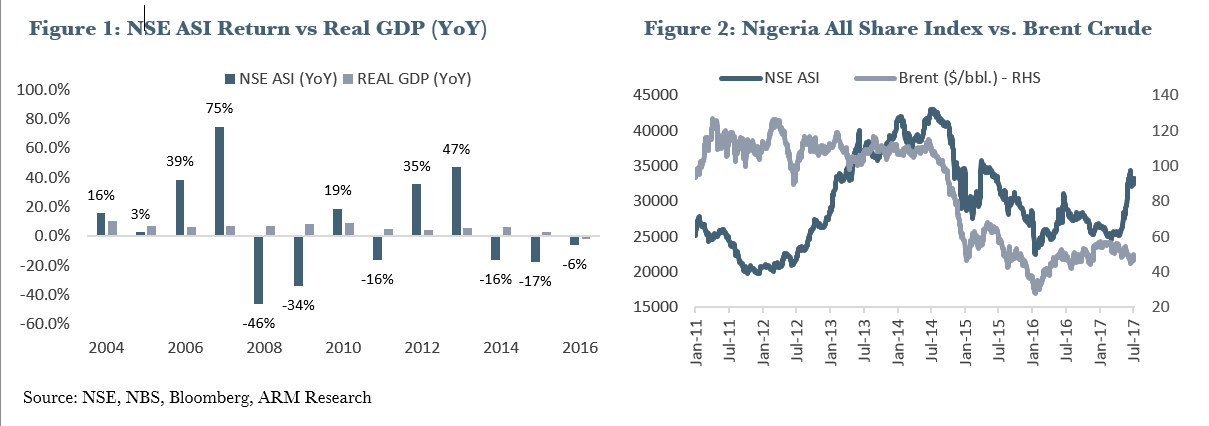
In Nigeria, for instance, the stock market performance has been firmly correlated with crude oil price expectations, external reserve, and exchange rate. Pointedly, with crude oil exports representing circa. 70% and 90% of fiscal and export revenues respectively, it is not surprising the level of correlation expected between the economy and crude oil price or production shocks. Elsewhere, foreign inflows into equity are also determined by future expectations about external reserve and overall exchange rate stability as foreigners concern themselves with relative ease of entry and exit.

So far, signs of economic improvements has guided our view that Nigeria will exit recession this year. The OPEC-led production cut has also raised crude prices globally to ~$52.5/barrel (vs 2016 average of $45.1/barrel). On the domestic production front, contraction in crude output have sizably shrank following improved government conciliation and an increase in government amnesty provision. This is even as force majeure on the nation’s largest export terminal (Trans Forcados) was lifted in May. The foregoing has thus driven improved revenue picture for the FG with expected rise in dollar influx expected to sustain FX liquidity in the near term. On the back of these, the equities market has rallied 22.72% YTD with more prospect for further upside.

Equity Investment


Wouldn’t you rather Invest now?

Before you start here, always remember stock prices are all about future earnings. Thus, with bullish economic and financial performance almost upon us, what the investment pros must be pricing in should be much rosier. Therefore, maximizing gains in the stock market requires looking past what’s about to happen and taking position in the market based on expectations of future performance. Earnings are about to come back into focus as second quarter reporting season gets set to kick off. Expectations are elevated. Investors may be hoping for more of a speed boat look to economic growth, but we believe that pontoon speed, while not exciting, is likely to be more beneficial to keeping the bull market going.

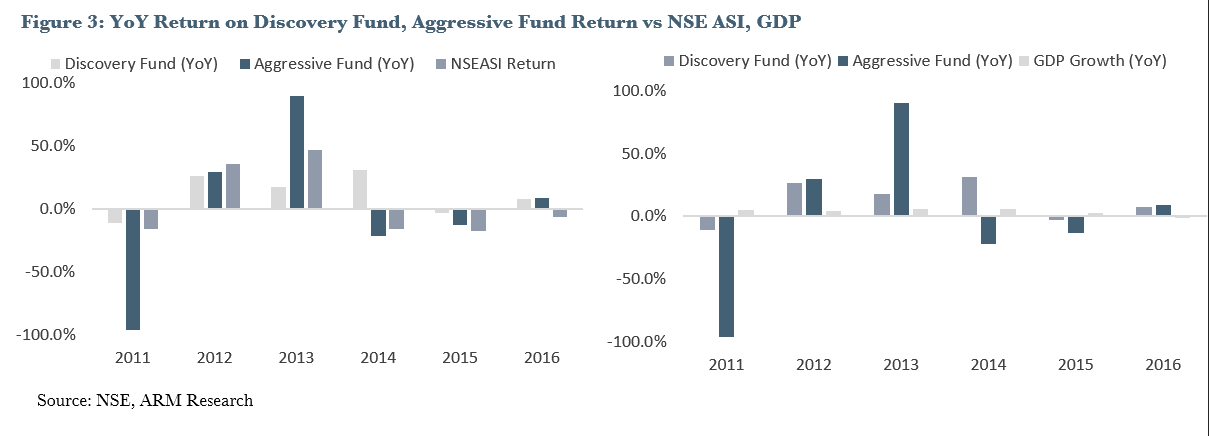
At ARM, we continue to build as well as prune our list of stocks. We pay specific attention to those with solid fundamentals or those that are unfairly being dragged down by the rest of the market—a case of “throwing the baby out with the bathwater.” These dislocations become widespread as many investors choose to flee or sell low during a correction rather than focus on the subsequent recovery. Having applied our framework, we stuck with our portfolio tilt towards stocks and we were net buyers of stocks in 2016 and, testament to our diligence, our funds benefited from the market rebound. Specifically, there is a strong correlation between the stock market and our Aggressive fund, due to its higher equity allocation (80-100%). The equity fund has constantly outperformed the market during periods of recovery or rebound.


The post When It Rains, It Pours: The case for Equity Investment appeared first on Realising Ambitions.

Source: Blog

African Economies: on Course for Divergent Fortunes

In today’s cut-out of our core strategy document – The Nigeria Strategy Report, we review developments in African Economies: Sub Saharan Africa as well as in North African climes over H1 17.  The section also provides insights on what we believe will be major drivers of both growth and overall investor sentiment for the rest of the year.

Given recently released data and forecast, Sub-Saharan Africa (SSA) is on course for a modest recovery in 2017 led by ongoing recoveries in some of its major economies. Specifically, powerhouse constituent—Nigeria—posted its slowest GDP contraction in four quarters in Q1 17 (-0.5% YoY) following slower contraction in crude production (Q1 17: -11% YoY to 1.83mbpd) and currency-led rebound in non-oil GDP (YoY: Q1 17: +0.7%) while its balance of trade extended its surplus position to a second consecutive quarter. In similar vein, the Angolan economy leveraged the OPEC-induced crude price rally to a position of relative comfort in Q1 17 with its government reportedly ramping up spending ahead of the country’s election in the period.

Elsewhere, growth picture in North Africa remained largely mixed with recent recovery in Tunisia and Morocco at one extreme.  The recent growths in Tunisia and Morocco were supported by increases in mining/phosphate production, agriculture, and tourism as well as surge in agricultural output. In Egypt, the economy is believed to have expanded 3.9% YoY in Q1 17 (vs. 3.8% YoY in Q4 16) as influx of investment capital greeted the country’s tilt to currency floatation towards the close of last year.

On balance, the IMF projects improvements in current account balances across SSA in 2017 following recovery in commodity prices with SSA oil exporters in pole position to benefit. Of note, OPEC’s nine-month extension of its November’s production cut deal appears to have provided a much-needed relief to SSA oil exporters in the form of higher export proceeds. This should be aided by pass-through from gradual implementation of pro-market policies in climes such as Nigeria, wherein improvements in FX liquidity have been observed following the introduction of the IEW and its apex bank’s sustained sales of dollars at all segments of the market. Irrespective, current growth expectation for the region is less sanguine relative to predictions in January with the IMF cutting its SSA growth forecast 20bps to align with World Bank’s estimate of 2.6% YoY over 2017.

In North Africa, Egypt’s pro-market policies appear to be generating desired responses from portfolio investors as well with the March influx into the country’s bond market a case in point. This is even as Morocco leverages on its resurging agriculture which has already underpinned its strong growth in Q1 17. Thus, although patches of weaknesses are still expected in Libya and Algeria, mean growth in North Africa should remain strong in 2017.


Read detailed report on African economies here